 ComputeSphere
From repo to running in one push
Connect a repo or start from a template — we build, deploy, and route it with SSL.
Everything you need to ship
Docs, an API, and a CLI — wired to the same platform your services run on.
5 Essential Tips for Cutting Cloud Infrastructure Expenses
Did you know that businesses waste an estimated 35% of their cloud spend on unused or idle resources? As cloud services become integral to modern business operations, managing these costs has never been more critical. While cloud infrastructure offers unparalleled scalability and flexibility, it also presents challenges in cost management. Without effective strategies, your cloud expenses can spiral out of control.
By implementing targeted cost-saving measures, you can optimize your cloud infrastructure and achieve significant savings. Here are five essential tips to help you reduce your cloud expenses and maintain a cost-efficient cloud environment.
Tips for Cutting Cloud Infrastructure Expenses
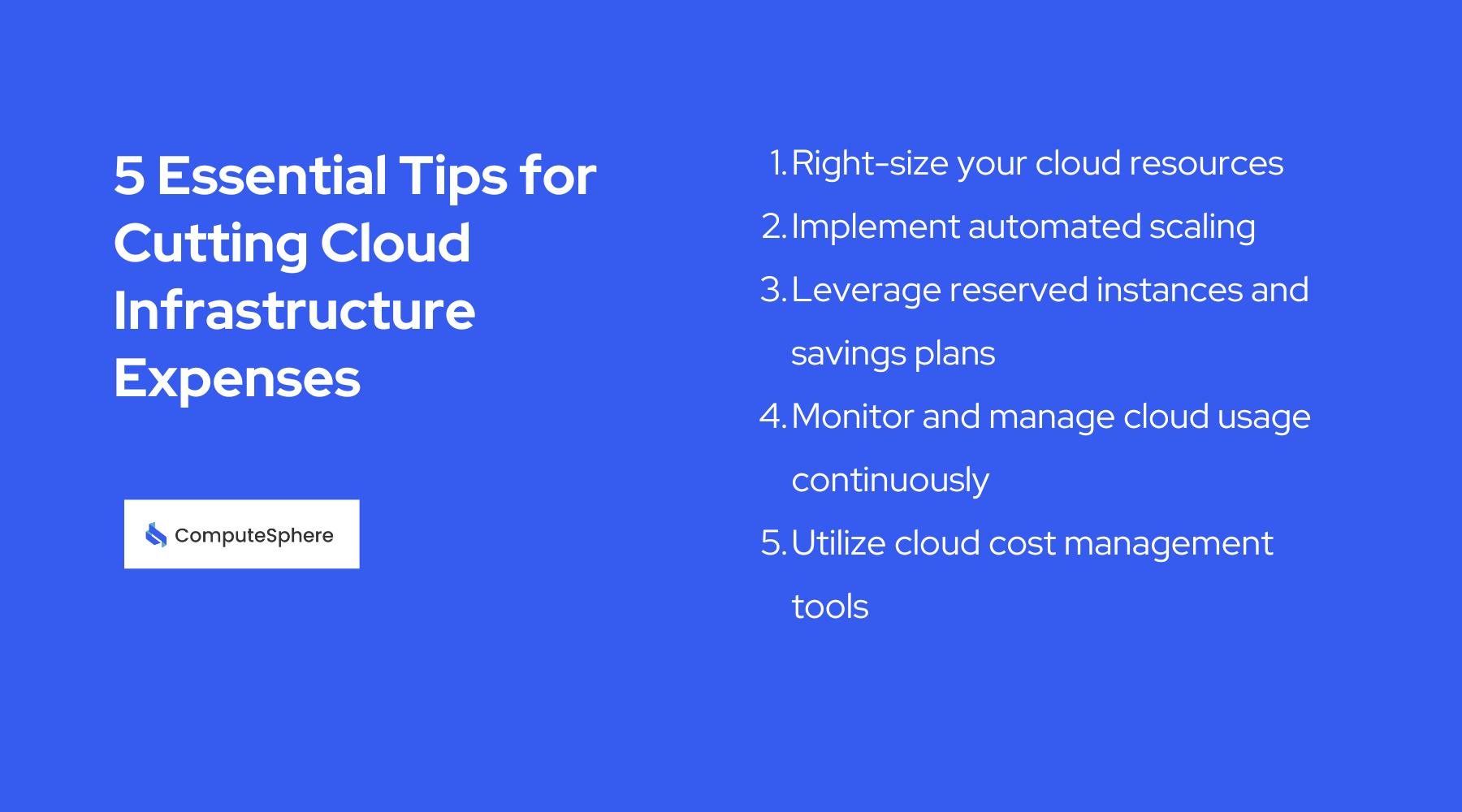
1: Right-Sizing Your Cloud Resources
One of the most effective ways to reduce cloud expenses is by right-sizing your resources. This involves adjusting your cloud resource allocation to match your actual usage needs. Over-provisioning can lead to wasted resources and increased costs, while under-provisioning can affect performance.
Start by assessing your current resource usage. Identify instances, storage, and services that are underutilized or over-provisioned. Use tools like AWS Trusted Advisor, Google Cloud's Recommender, and Azure Advisor to gain insights into your resource utilization.
Right-sizing your resources not only saves costs but also ensures that your resources are being used efficiently.
2: Implementing Automated Scaling
Automated scaling can significantly impact your cloud cost management strategy. By configuring your cloud services to automatically scale up or down based on demand, you can optimize resource usage and reduce costs.
To set up automated scaling, start by defining scaling policies that suit your workload. Most cloud providers, including AWS, Google Cloud, and Azure, offer built-in auto-scaling features. Configure your services to scale in response to specific metrics, such as CPU usage or network traffic.
By utilizing automated scaling, you ensure optimal performance during high-demand periods and cost savings during low-demand periods.
3: Using Reserved Instances and Savings Plans
Another powerful strategy for reducing cloud expenses is using reserved instances and savings plans. These options allow you to commit to using specific resources for a longer period, usually one to three years, in exchange for significant discounts compared to on-demand pricing.
When choosing between pay-as-you-go and reserved instances, consider your usage patterns. If you have predictable workloads, reserved instances can offer substantial savings. AWS, for instance, offers up to 75% savings with reserved instances.
By selecting the right reserved instances and savings plans, you can achieve significant reductions in your cloud expenses.
4: Monitoring and Managing Cloud Usage
Continuous monitoring is important for effective cloud cost optimization. By keeping a close eye on your cloud usage, you can identify and address cost anomalies before they become significant issues.
Use tools like CloudWatch, CloudTrail, and Google Stackdriver to monitor your cloud environment. Set up alerts for unexpected spikes in usage or costs. Regularly review your usage reports to identify trends and areas for improvement.
Effective monitoring helps you maintain control over your cloud expenses and avoid unexpected cost overruns.
5: Utilizing Cost Management Tools
Investing in cloud cost management tools can provide you with the insights and control needed to optimize your cloud budget. These tools offer features such as budgeting, forecasting, and cost allocation, helping you manage your expenses more effectively.
Popular tools like CloudHealth, CloudCheckr, and AWS Cost Explorer provide detailed analytics and recommendations for optimizing your cloud spend. Integrate these tools into your cloud infrastructure to gain better visibility and control over your expenses.
Using cost management tools allows you to streamline your cloud operations and achieve significant cost savings.
The Importance of a Proactive Approach
Proactively managing your cloud expenses is not just about implementing the right tools and strategies—it's about building a culture of cost awareness within your organization. Educate your team about the importance of cloud cost optimization and encourage them to identify potential savings. Regularly review your cloud usage and expenses to ensure that your optimization strategies are effective and up-to-date.
Conclusion
Managing cloud infrastructure expenses is more than important for maintaining a cost-effective and efficient cloud environment. By implementing these five tips—right-sizing your resources, utilizing automated scaling, using reserved instances and savings plans, continuously monitoring your usage, and investing in cost management tools—you can greatly reduce your cloud expenses.
Remember, effective cloud cost optimization not only saves money but also ensures that your cloud infrastructure supports your business goals efficiently. With a proactive approach to cloud cost management, you can maximize the value of your cloud investments and drive your business forward.
Contents
Predictable cloud, from your first push.
Fixed price per spherelet, flat plan per team — ship without DevOps or surprise bills.
Start free trial14-day free trial
Share this article
Ship your next service on ComputeSphere
Predictable per-spherelet pricing, a flat plan per team, and managed primitives built in — no DevOps, no surprise bills.
Browse Some Related Blogs
Relevant and related contents you can read
Deploy your first app in minutes.
Connect a repo or start from a template — live URL, SSL, and zero DevOps, on predictable monthly pricing. 14-day free trial.