 ComputeSphere
From repo to running in one push
Connect a repo or start from a template — we build, deploy, and route it with SSL.
Everything you need to ship
Docs, an API, and a CLI — wired to the same platform your services run on.
Best Cloud Security Practices to Address Vulnerabilities
Cloud computing has become an essential part of modern business operations, providing numerous benefits such as flexibility, scalability, and cost-effectiveness. However, increasing the use of cloud services also exposes organizations to a variety of security risks. Although cloud security vulnerabilities are varied and constantly changing, some common vulnerabilities include data breaches, insecure APIs, misconfigurations, inadequate logging and monitoring, and account hijacking.
This article explores the best practices to address these vulnerabilities and ensure the security of your cloud environment.
Cloud Security Vulnerabilities
To implement effective security measures, it is important to understand the various types of vulnerabilities that can affect cloud environments. There are many sources of vulnerabilities, such as misconfigurations, weak access controls, and software vulnerabilities.
Cloud security vulnerabilities include the following types:
Data Breaches
The unauthorized acquisition of confidential data is a significant issue. Data breaches may expose confidential information, which could result in financial losses and harm your reputation. For example, a Facebook breach in 2021 showed the personal information of approximately 530 million users due to a misconfiguration.
Insecure APIs
Although APIs are necessary for automation and cloud integration, there are serious security risks associated with unsecured APIs. Attackers may take advantage of APIs if appropriate authorization and authentication procedures aren't in place.
Data breaches may result from APIs that expose sensitive data without sufficient security, and injection attacks such as SQL injection may target APIs that fail to validate input. Strong authentication and authorization must be implemented, all inputs must be validated, and API gateways must be used to control and record API traffic to secure APIs.
Misconfiguration
Cloud security vulnerabilities are frequently caused by misconfigurations. Cloud resources are vulnerable to attack if they are not set up correctly. For Instance, If sensitive data is stored in open storage containers, there may be data leaks. Similar to how incorrectly configured security groups could allow illegal access to cloud services, utilizing default credentials can facilitate an attacker's entry.
These problems can be avoided by following recommended procedures for configuring cloud resources, using automated tools to find misconfigurations, and routinely checking your cloud settings.
Insufficient logging and Monitoring
It's difficult to identify security incidents and take quick action in the event of insufficient logging and monitoring. It becomes challenging to identify and address events as they happen without real-time monitoring. Investigations into incidents may become more difficult if incomplete or unavailable logs are the product of poor log management procedures.
Furthermore, security professionals may overlook crucial indicators of a compromise if warnings for suspicious activity are not set up. These vulnerabilities can be addressed by putting in place tools for continuous monitoring, making sure that all logging is done thoroughly, and setting up alarms for unusual activity.
Account Hijacking
When hackers obtain illegal access to user accounts, it's known as account hijacking. This is frequently the result of scams, password reuse, or weak password vulnerabilities. Attackers can access confidential information, carry out unethical actions, and assume the identity of the account holder once they get control of an account. Strong password limitations, multi-factor authentication (MFA), and user education regarding hacking and password security are all necessary to prevent account hijacking.
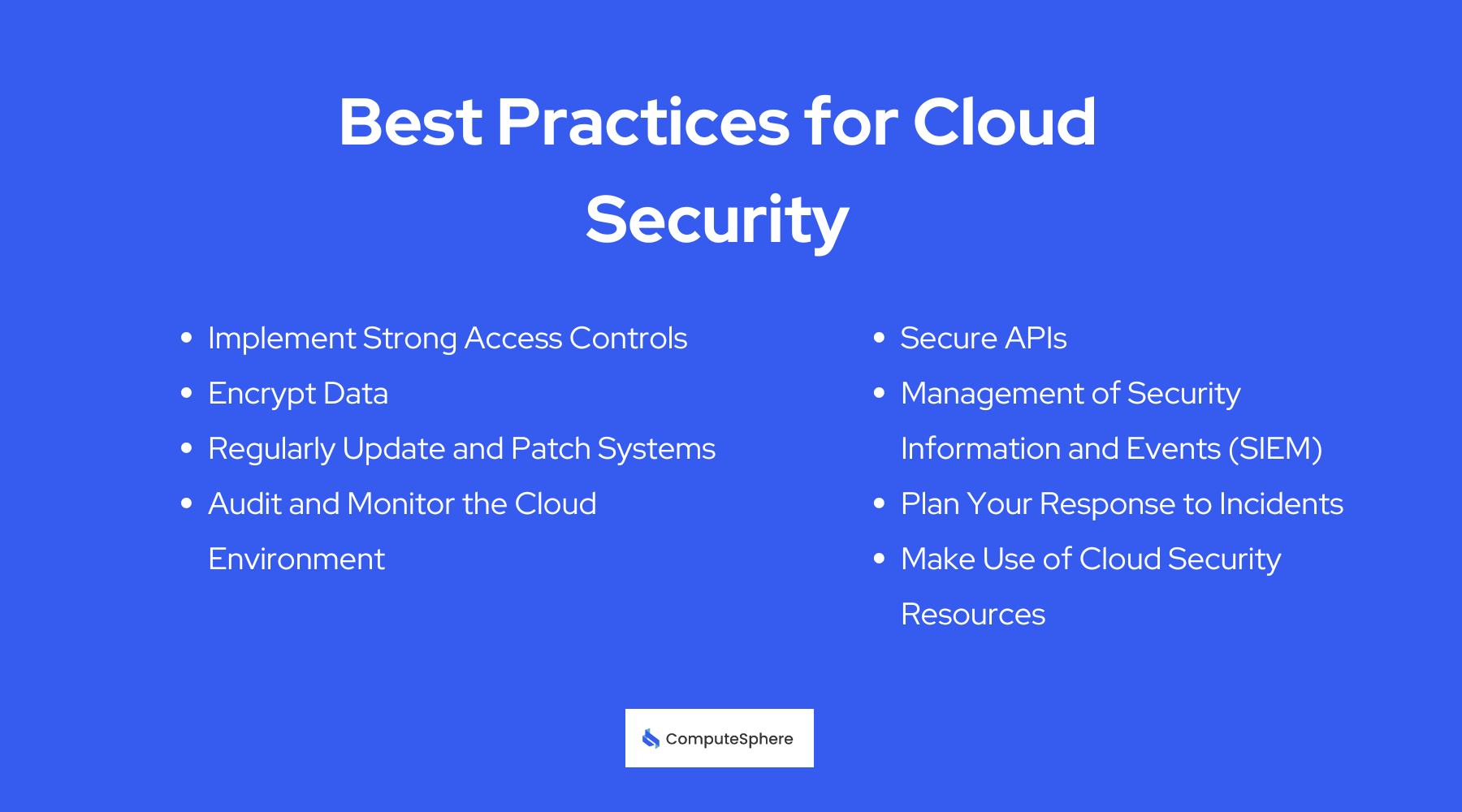
Best Practices for Cloud Security
To protect your cloud environment, follow these best practices:
Implement Strong Access Controls
Cloud security relies heavily on effective access control. By demanding various forms of authentication before giving access, Multi-Factor Authentication (MFA) offers an extra layer of protection. This lessens the possibility of unwanted access even if passwords are compromised.
Microsoft claims that 99.9% of account compromise attempts can be avoided by turning on MFA. Additionally, limiting the attack surface lowers the risk of internal threats, and granting users only the permissions they require helps to minimize the possible damage in the event of a breach.
Encrypt Data
Data protection requires the use of encryption. It makes sure that if data is intercepted, it can't be decrypted and read without the key. Files, databases, and backups can all be shielded against unwanted access by encrypting their stored data (data at rest).
Encryption services for data at rest are integrated into cloud providers such as AWS and Azure. Data in transit, or information traveling between your network and the cloud, can be encrypted to avoid being intercepted or altered. Transferring data securely is ensured by using TLS and HTTPS.
Regularly Update and Patch Systems
Updating systems is essential to defending against vulnerabilities that are already known. By ensuring that you constantly run the most recent, secure versions of your cloud services, you may minimize the amount of time you are exposed to known vulnerabilities by turning on automated updates. An effective patch management plan incorporating timely patch deployments and routine evaluations can reduce the hazards associated with outdated software.
Audit and monitor the cloud environment
Security concerns must be identified and addressed through regular audits and continuous monitoring. To respond quickly to security problems, use monitoring technologies to identify unusual activity and possible threats in real-time.
Comprehensive monitoring is offered by services such as AWS CloudTrail and Azure Monitor. Maintaining security hygiene and finding hidden vulnerabilities can be facilitated by conducting routine audits of your cloud infrastructure, which can assure policy compliance and configuration concerns.
Secure APIs
API security is critical since APIs are essential to cloud operations. Security measures like rate limitation and IP whitelisting can be enforced by using API gateways to control and safeguard API traffic.
Strong API management and security are provided by services like Google Cloud Desktops and laptops and AWS API Gateway. Regularly testing your APIs for security helps find vulnerabilities and close them, making sure that security lapses are quickly closed.
Management of Security Information and Events (SIEM)
SIEM solutions give you a thorough understanding of your cloud environment and assist in identifying and addressing security issues. SIEM technologies gather and examine log data from several sources, with instant insights into security incidents and assisting in the identification of trends suggesting possible dangers.
For SIEM applications, tools like IBM QRadar and Splunk are widely used. It is imperative to ensure that your SIEM system is integrated with your cloud services to facilitate efficient monitoring and incident response. This will allow for smooth data flow and improved threat detection throughout the cloud environment.
Plan your response to incidents
Managing security events requires a well-defined incident response plan. The actions to be taken in the event of a security breach, such as detection, containment, eradication, and recovery, should be outlined in your plan.
An organized reaction guarantees that situations are managed effectively. To ensure that your incident response plan stays effective and to prepare your team for real-world circumstances, conduct frequent exercises to test it and adapt it as necessary to address new threats.
Make Use of Cloud Security Resources
You can secure your infrastructure using a variety of cloud security options. Attack detection systems (IDS), firewalls, and security information and event management (SIEM) systems are some examples of these tools. Make use of these resources to improve your security posture. Furthermore, a lot of cloud service providers provide integrated security measures that you may adjust to suit your security requirements.
Transitioning to a Secure Cloud Environment
The process of transitioning to a secure cloud environment involves several steps.
Create a security plan
The first step to ensuring security is developing a comprehensive security plan. It should describe your security objectives, the measures you will take to achieve them, and the roles and responsibilities of your security team. Implementing and maintaining cloud security requires a well-defined plan.
Selecting the Right Cloud Provider
Selecting the ideal cloud service provider is essential. Consider evaluating possible suppliers based on their compliance certifications, track record, and security offerings. Make sure that the security procedures used by the provider meet the security needs of your company. The provider's capacity to meet your security requirements as your company expands should also be taken into account.
Move Safely
Make sure that the transfer procedure is secure when moving to the cloud. Encrypt data while it's in transit, and after a migration, make sure it's still intact. Before and after the migration, do security assessments to find and fix any vulnerabilities that might have been introduced.
Conclusion
The first step toward protecting your cloud infrastructure is to understand cloud security vulnerabilities. By identifying these vulnerabilities, you can implement appropriate security measures to mitigate risks and safeguard your data. Comprehensive cloud security strategies include regular security assessments, strong access controls, data encryption, secure APIs, continuous monitoring, prompt patching, employee training, and using cloud security tools.
Taking a proactive approach to cloud security will keep your organization safe from potential threats and help protect its valuable assets. Security in the cloud is a journey that never ends.
Contents
Predictable cloud, from your first push.
Fixed price per spherelet, flat plan per team — ship without DevOps or surprise bills.
Start free trial14-day free trial
Share this article
Ship your next service on ComputeSphere
Predictable per-spherelet pricing, a flat plan per team, and managed primitives built in — no DevOps, no surprise bills.
Browse Some Related Blogs
Relevant and related contents you can read
Deploy your first app in minutes.
Connect a repo or start from a template — live URL, SSL, and zero DevOps, on predictable monthly pricing. 14-day free trial.