 ComputeSphere
From repo to running in one push
Connect a repo or start from a template — we build, deploy, and route it with SSL.
Everything you need to ship
Docs, an API, and a CLI — wired to the same platform your services run on.
Setting Up DevOps Practices in Cloud Infrastructure: More Efficiency and Security
The ability to deploy software swiftly and securely is a critical competitive edge in the current digital cloud environment. Companies that adopt DevOps practices can often deploy code up to 30 times more frequently than their competitors, all while maintaining powerful security. Integrating DevOps into your cloud infrastructure combines development and operations to improve collaboration, efficiency, and reliability.
This formal approach ensures your software development processes are both agile and secure. If you're looking to improve your cloud operations and achieve these benefits, here is how you can effectively implement DevOps practices in your cloud infrastructure.
Understanding DevOps in Cloud Infrastructure
DevOps, a fusion of “development” and “operations,” is a cultural and operational shift that merges these two traditionally siloed areas. The main goal is to improve collaboration and productivity, ultimately resulting in faster and more reliable software delivery.
In the context of cloud infrastructure, DevOps allows for better resource management. By automating and integrating the processes, DevOps enables teams to build, test, and release software more efficiently.
Cloud platforms like AWS, Azure, and Google Cloud offer services that support DevOps practices, making it easier to automate infrastructure management and application deployment.
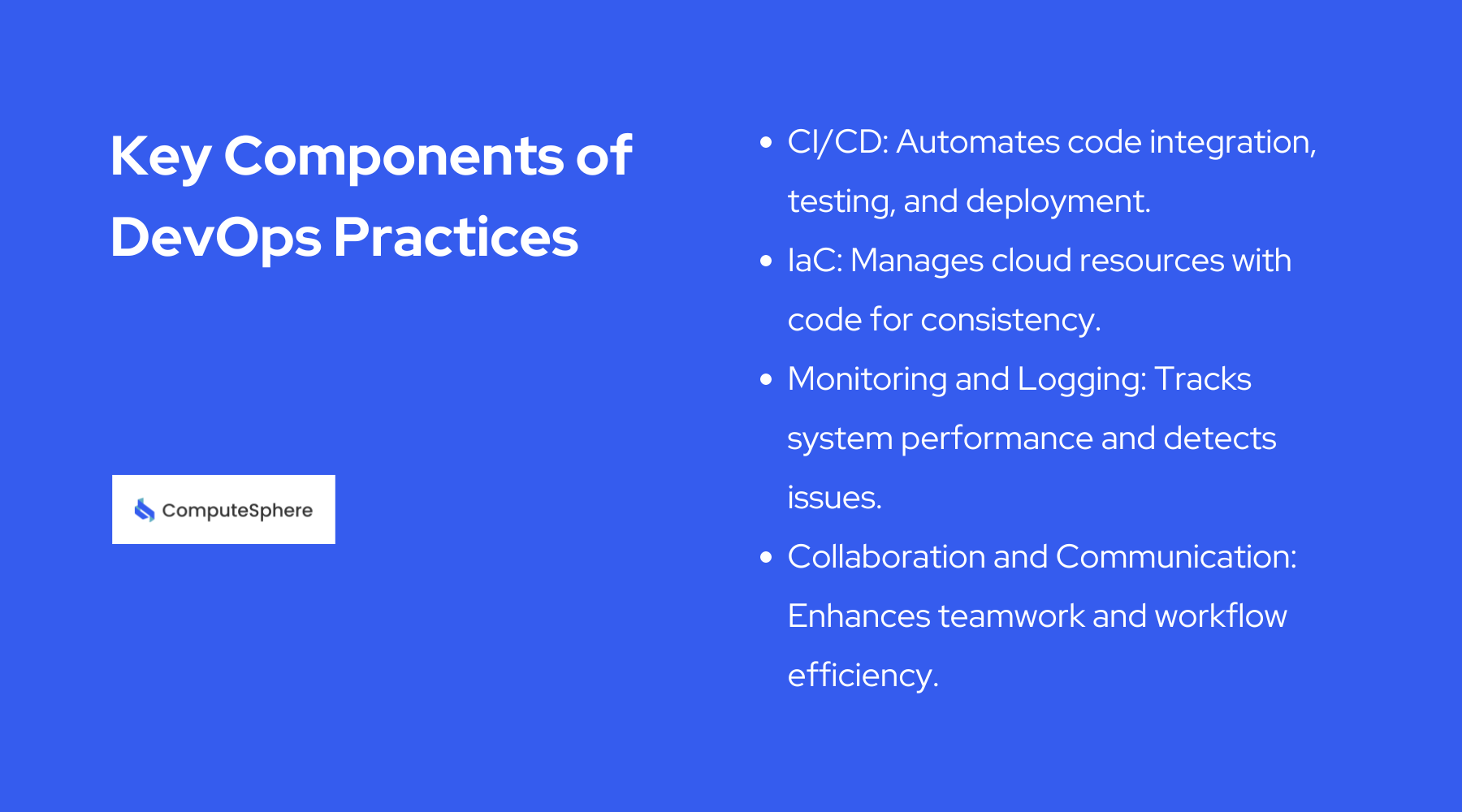
Key Components of DevOps Practices
To effectively set up DevOps in your cloud infrastructure, you need to focus on several key components:
Continuous Integration and Continuous Deployment (CI/CD)
CI/CD pipelines are the backbone of DevOps practices. They automate the process of integrating code changes, running tests, and deploying to production, ensuring that new features and fixes are delivered quickly with minimal manual intervention. Tools like Jenkins, CircleCI, or GitLab Actions can streamline these processes.
Setting Up CI/CD Pipelines in the Cloud
Creating a CI/CD pipeline is an important step in adopting DevOps in your cloud infrastructure. Here’s how you can set it up:
-
Choose the Right Tools: Select tools based on your cloud provider, such as AWS CodePipeline, Azure DevOps, or Google Cloud Build, to automate build, test, and deployment processes.
-
Configure Pipelines Securely: Integrate security checks at every stage to protect against vulnerabilities. Tools like Snyk or Aqua Security can help scan for issues throughout the pipeline.
-
Automate Testing and Deployment: Implement automated testing to catch bugs early in the development cycle and automated deployments to ensure consistency and speed, reducing the risk of human error.
Implementing Infrastructure as Code (IaC)
IaC is a foundational element of DevOps, allowing you to manage your cloud infrastructure using configuration files. This ensures consistency and reproducibility across environments. You can get started as follows:
Select a suitable IaC tool. Popular options include Terraform, AWS CloudFormation, and Azure Resource Manager. Choose one based on your cloud provider and team's expertise.
Write maintainable code. Follow best practices for writing IaC scripts, such as using modular templates and keeping your code clean and well-documented. This makes it easier to manage and update your infrastructure.
Automate the provisioning and management of your cloud resources using your IaC scripts. This approach ensures that your environments are consistent and reproducible, reducing the risk of configuration drift.
Monitoring and Logging in Cloud Infrastructure
Monitoring and logging provide visibility into your systems, allowing you to detect and respond to issues quickly. Here’s how to set up effective monitoring and logging:
First, choose the right monitoring and logging tools. Some popular options include Prometheus and Grafana for open-source solutions, the ELK Stack (Elasticsearch, Logstash, Kibana) for a comprehensive logging solution, and cloud-native options like AWS CloudWatch, Azure Monitor, and Google Cloud Logging.
Once you have selected the tools, set up alerts to notify your team of any potential issues. Automate responses where possible to quickly address common problems and reduce downtime, ensuring that any issues are promptly resolved.
Improving Cloud Security and Compliance
Security and compliance are important in DevOps practices. Start by implementing best practices like multi-factor authentication (MFA), strong passwords, and the principle of least privilege. Use tools like AWS Security Hub, Azure Security Center, and Google Cloud Security Command Center to monitor and address vulnerabilities. Ensure regular updates and patches for all software to mitigate security risks.
For compliance, understand your industry's requirements, such as GDPR, HIPAA, and SOC 2. Use tools like AWS Compliance Center and Azure Policy to meet regulatory standards. Regularly audit your cloud infrastructure to maintain compliance and address issues promptly.
Protecting Cloud Data and Automating Security Checks
Encrypt data at rest and in transit using tools like AWS Key Management Service (KMS) and Google Cloud Data Loss Prevention (DLP). Implement regular backup and recovery plans to ensure quick recovery from data loss incidents. Monitor data access for unusual activity and set up alerts to detect potential breaches early.
Integrate security tools into your CI/CD pipelines, such as Snyk and Aqua Security mentioned above, to scan for vulnerabilities. Automate compliance checks to continuously meet regulatory requirements, and regularly update security policies to adapt to new threats.
Conclusion
Implementing DevOps practices in your cloud infrastructure can truly improve your operations. By following the steps, you'll be well-equipped to create a strong, secure, and efficient cloud environment. Starting DevOps is not just about adopting new tools and technologies; it's about building a culture of continuous improvement and collaboration.
As you integrate these practices, you'll notice not only improved operational efficiency but also a significant rise in security and compliance. Start your DevOps journey and watch your cloud infrastructure reach new heights of performance and reliability.
Contents
Predictable cloud, from your first push.
Fixed price per spherelet, flat plan per team — ship without DevOps or surprise bills.
Start free trial14-day free trial
Share this article
Ship your next service on ComputeSphere
Predictable per-spherelet pricing, a flat plan per team, and managed primitives built in — no DevOps, no surprise bills.
Browse Some Related Blogs
Relevant and related contents you can read
Deploy your first app in minutes.
Connect a repo or start from a template — live URL, SSL, and zero DevOps, on predictable monthly pricing. 14-day free trial.